---
title: "Foam Pit Blocks: Ideal Materials for Gyms, Parks & Training Facilities"
description: Discover how foam pit blocks enhance safety and performance in gyms, parks and training facilities with superior impact absorption and durability.
image: https://solutions.sterlinghouston.com/hubfs/iStock-2163134568.jpg
---
[CALL US TODAY: 713.695.5333](tel:713.695.5333)
[EMAIL US: INFO@STERLINGHOUSTON.COM](mailto:info@sterling.com)
[](https://sterlinghouston.com/)
- [HOME](https://sterlinghouston.com/)
- [About Us](https://sterlinghouston.com/about-us/)
- [Services](https://sterlinghouston.com/services/)
- [Packaging Solutions](https://sterlinghouston.com/packaging-solutions/)
- [Contour cutting](https://sterlinghouston.com/contour-cutting/)
- [Die-Cutting](https://sterlinghouston.com/die-cutting/)
- [Dimensional Cutting](https://sterlinghouston.com/dimensional-cutting/)
- [Laminating & Bonding](https://sterlinghouston.com/laminating-bonding/)
- [Logistic Support](https://sterlinghouston.com/logistic-support/)
- [Convoluting](https://sterlinghouston.com/convoluting/)
- [Products](https://sterlinghouston.com/products/)
- [Foam Cubes](https://sterlinghouston.com/foam-cubes/)
- [Expandable Polystyrene (EPS)](https://sterlinghouston.com/expandable-polystyrene-eps/)
- [Polyurethane Foam (PU)](https://sterlinghouston.com/polyurethane-foam-pu/)
- [Ether](https://sterlinghouston.com/ether/)
- [Ester](https://sterlinghouston.com/ester/)
- [Polyethylene (PE)](https://sterlinghouston.com/polyethylene-pe/)
- [Design & Testing](https://sterlinghouston.com/design-testing/)
- [Contact Us](https://sterlinghouston.com/contact-us/)
- [Blog](https://solutions.sterlinghouston.com/blog)
[REQUEST A SAMPLE BOX](https://sterlinghouston.com/request-a-sample-box/)
[REQUEST A SAMPLE BOX](https://sterlinghouston.com/request-a-sample-box/)
# Foam Pit Blocks: Ideal Materials for Gyms, Parks & Training Facilities
[Leave a Comment](https://solutions.sterlinghouston.com/blog/foam-pit-blocks-ideal-materials-for-gyms-parks-training-facilities#reply-title) / [Athletics](https://solutions.sterlinghouston.com/blog/tag/athletics), [Foam Solutions](https://solutions.sterlinghouston.com/blog/tag/foam-solutions), [Recreation](https://solutions.sterlinghouston.com/blog/tag/recreation) / [By Sterling Marketing](https://solutions.sterlinghouston.com/blog/author/sterling-marketing)
Teaching gymnasts and other athletes how to fall safely is one of the smartest investments a facility can make in long-term athletic development.
As [one gym director and coach put it](https://skylarksports.com.au/why-falling-is-part-of-gymnastics/), the goal is not to avoid falling altogether, but to be prepared when it happens. The result is stronger, smarter, and more confident athletes.
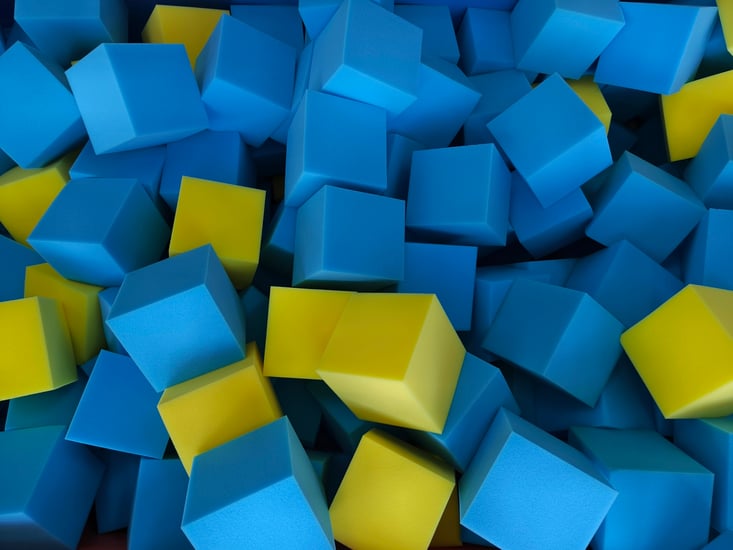
Gym, park, and training facility operators understand that safe landings are essential, which is why spaces must be designed around how users land, fall, and recover. That is where **foam pit blocks**, often referred to as [foam cubes](https://sterlinghouston.com/foam-cubes/), play a critical role.
These blocks form the foundation of controlled landing zones in facilities that support gymnastics, trampoline sports, parkour, and other tumbling-based training. By absorbing impact and reducing injury risk, foam pit blocks allow athletes and participants to train harder and progress without fear.
As high-impact and extreme sports continue to expand into schools, park programs, and private training centers, facility owners are placing greater emphasis on foam pit systems that deliver consistent performance, durability, and long-term value.
## **What Are Foam Pit Blocks?**
Foam pit blocks are freestanding foam components stacked or layered to create a cushioned pit surface. Together, they form a flexible landing zone that absorbs energy while allowing users to move, roll, and exit safely. These blocks are essential for maintaining safety and confidence in training environments that prioritize high-intensity movement.
#### **Types of Foam Pit Blocks**
Different training activities call for specific foam characteristics. Common types include:
- **Standard Foam Blocks**: Widely used in gymnastics pits and trampoline parks, these lightweight cubes provide reliable shock absorption and are easy to rearrange as needed.
- **High-Density Foam Blocks**: Designed for higher-traffic or high-impact environments, these firmer blocks offer greater durability and longevity.
- **Custom-Shaped Foam Blocks:** Foam can also be fabricated into custom sizes or shapes for unique pit layouts, angled transitions, or specialized athletic training setups.
#### **Materials Used in Foam Pit Blocks**
- [Polyurethane Foam](https://sterlinghouston.com/polyurethane-foam-suppliers/): The most common material, polyurethane offers excellent impact absorption, resilience, and consistent performance under repeated use.
- **EVA Foam:** Often found in specialty applications, EVA foam adds rigidity, moisture resistance, and enhanced durability for demanding environments.
#### **Size and Shape Variations**
Foam pit blocks come in a range of sizes, from small cubes to larger rectangular blocks. The ideal dimensions depend on pit depth, activity type, and the desired level of firmness or resistance. Custom sizing options help facilities fine-tune the balance between safety, comfort, and performance.
## **Why Foam Pit Blocks Are Ideal for Gyms, Parks, and Training Facilities**
Foam pit blocks stand out as a preferred safety material because they combine reliable impact cushioning with long-term durability. Whether used for gymnastics, trampoline activities, or tactical training, they provide consistent protection and performance for all users.
##### ***Impact Absorption and Injury Reduction***
Foam pit blocks are designed to dissipate impact energy, reducing stress on joints and minimizing the risk of injury. They’re particularly effective for:
- Gymnastics dismounts and skill development.
- Trampoline park aerial maneuvers.
- Parkour and obstacle course training.
- Tactical and athletic fall training.
By creating predictable, forgiving landing zones, foam cubes support confident skill progression without hesitation.
##### ***Durability for High-Use Environments***
High-quality foam pit blocks retain their shape and density even after repeated compression. This durability minimizes breakdown, reduces replacement cycles, and keeps facilities running smoothly with less downtime.
##### ***Customization and Facility Integration***
Foam pit systems can be customized to match a facility’s layout, branding, and functional requirements. Options for block size, density, and color make it easy to design a pit that blends seamlessly into the surrounding space while meeting exact performance needs.
##### ***Maintenance and Hygiene Considerations***
Modern foam pit blocks often include treatments or covers that resist moisture, odors, and bacteria. These features simplify cleaning, improve sanitation, and maintain a healthy training environment. Waterproof and outdoor-rated options are also available for facilities exposed to humidity or the elements.
##### ***Applications of Foam Pit Blocks Across Different Environments***
The versatility of foam pit blocks makes them valuable in a wide range of facilities. From athletic training to public recreation and tactical instruction, these impact-absorbing materials enhance safety and support skill development across multiple settings.
##### ***Gyms and Fitness Centers***
In gymnastics facilities and specialized training gyms, foam pit blocks create controlled landing zones that promote safe skill progression. Athletes use foam pits to practice dismounts, flips, and complex maneuvers with less fear of injury, allowing them to refine technique and build confidence.
##### ***Parks and Recreation Facilities***
Municipal park systems and recreation departments increasingly use foam pit blocks in playgrounds, obstacle courses, and extreme sports zones. These systems lower injury risk in spaces designed for diverse age groups and activity levels, supporting inclusive participation and fun.
##### ***Training and Tactical Facilities***
Foam pit blocks also play a vital role in military, law enforcement, and professional training environments. They offer a realistic yet safe surface for fall training, tactical movement, and high-impact drills, helping participants build strength, coordination, and confidence in dynamic scenarios.
## **How to Choose the Right Foam Pit Blocks for Your Facility**
Selecting the right foam pit blocks ensures your facility maintains safety, performance, and cost efficiency over time. The following factors can help guide your decision:
#### **Evaluate Impact and Activity Requirements**
Assess how the pit will be used, including the height of falls, frequency of landings, and skill level of participants. Higher-impact activities often require denser foam blocks or deeper pits to provide adequate energy absorption and injury protection.
#### **Balance Durability and Maintenance**
For facilities with high daily traffic, durability should be a top priority. High-density foam blocks retain their structure longer, resist breakdown under repeated use, and typically deliver a better long-term return on investment with fewer replacements needed.
#### **Verify Safety Standards**
Always ensure that foam pit blocks meet recognized safety and material standards. Fire-retardant, non-toxic foams are essential in commercial or public training environments, where user safety and compliance are key considerations.
## **Design and Performance Benefits of Foam Pit Blocks**
Beyond safety, foam pit blocks also enhance the visual and functional design of athletic environments. Available in a wide range of colors, they can align with facility branding, designate training zones, or simply make the space more engaging and dynamic.
Color organization can also support skill progression, allowing coaches and athletes to visually separate different activity zones or performance levels.
Foam pit blocks (also known as foam cubes) play a vital role in the design of gyms, parks, and training facilities. Their impact absorption, durability, and adaptability make them an essential foundation for safe and high-performing spaces.
Investing in high-quality foam pit blocks protects users, supports skill development, and maximizes the long-term value of your facility. [Contact Sterling Manufacturing today](https://sterlinghouston.com/request-a-sample-box/) to learn more about custom foam cube and pit block solutions designed for gyms, parks, and training environments.
[← Previous Post](https://solutions.sterlinghouston.com/blog/which-foam-is-right-best-foam-packaging-for-fragile-shipments)
[Next Post →](https://solutions.sterlinghouston.com/blog/recyclings-expanding-role-in-foam-production-and-fabrication)
### Leave a Comment
Your email address will not be published. Required fields are marked \*
This is a search field with an auto-suggest feature attached.
- There are no suggestions because the search field is empty.
###### Recent Posts
[Foam Solutions for Oil & Gas Industry Applications](https://solutions.sterlinghouston.com/blog/foam-solutions-for-oil-gas-industry)
[Advanced Foam Solutions in Oil & Gas: Custom Protective Packaging](https://solutions.sterlinghouston.com/blog/advanced-foam-oil-and-gas)
[Foam Material in Automotive Design: Performance, Comfort and Efficiency](https://solutions.sterlinghouston.com/blog/foam-material-in-automotive-design-performance-comfort-and-efficiency)
[How Foam Enhances Athlete Performance and Safety in Gymnastics](https://solutions.sterlinghouston.com/blog/gymnastics-foam-cubes)
[Medical Industry Foam Solutions: Safe Transport of Vital Equipment](https://solutions.sterlinghouston.com/blog/medical-industry-foam-solutions-safe-transport-of-vital-equipment)
[Foam Finger Frenzy](https://solutions.sterlinghouston.com/blog/foam-finger-frenzy)
###### Categories
- [Foam Solutions](https://solutions.sterlinghouston.com/blog/tag/foam-solutions)
- [Packaging](https://solutions.sterlinghouston.com/blog/tag/packaging)
- [General](https://solutions.sterlinghouston.com/blog/tag/general)
- [EPS](https://solutions.sterlinghouston.com/blog/tag/eps)
- [Shipping](https://solutions.sterlinghouston.com/blog/tag/shipping)
- [Medical](https://solutions.sterlinghouston.com/blog/tag/medical)
- [Athletics](https://solutions.sterlinghouston.com/blog/tag/athletics)
- [Custom foam](https://solutions.sterlinghouston.com/blog/tag/custom-foam)
- [Oil & Gas](https://solutions.sterlinghouston.com/blog/tag/oil-gas)
- [Automotive](https://solutions.sterlinghouston.com/blog/tag/automotive)
- [Construction](https://solutions.sterlinghouston.com/blog/tag/construction)
- [Die-Cutting](https://solutions.sterlinghouston.com/blog/tag/die-cutting)
- [Electronics](https://solutions.sterlinghouston.com/blog/tag/electronics)
- [Fabrication](https://solutions.sterlinghouston.com/blog/tag/fabrication)
- [Polyurethane Foam](https://solutions.sterlinghouston.com/blog/tag/polyurethane-foam)
- [Safety](https://solutions.sterlinghouston.com/blog/tag/safety)
- [Foam acoustic solutions](https://solutions.sterlinghouston.com/blog/tag/foam-acoustic-solutions)
- [Manufacturing](https://solutions.sterlinghouston.com/blog/tag/manufacturing)
- [Military and Defense](https://solutions.sterlinghouston.com/blog/tag/military-and-defense)
- [Foam Inserts](https://solutions.sterlinghouston.com/blog/tag/foam-inserts)
- [Polyethylene Foam](https://solutions.sterlinghouston.com/blog/tag/polyethylene-foam)
- [Award](https://solutions.sterlinghouston.com/blog/tag/award)
- [News](https://solutions.sterlinghouston.com/blog/tag/news)
- [Contour](https://solutions.sterlinghouston.com/blog/tag/contour)
- [Furniture](https://solutions.sterlinghouston.com/blog/tag/furniture)
- [Pipeline Insulation](https://solutions.sterlinghouston.com/blog/tag/pipeline-insulation)
- [Recycling](https://solutions.sterlinghouston.com/blog/tag/recycling)
- [Supply Chain](https://solutions.sterlinghouston.com/blog/tag/supply-chain)
- [Aerospace](https://solutions.sterlinghouston.com/blog/tag/aerospace)
- [CNC Cutting](https://solutions.sterlinghouston.com/blog/tag/cnc-cutting)
- [EVA](https://solutions.sterlinghouston.com/blog/tag/eva)
- [Industrial](https://solutions.sterlinghouston.com/blog/tag/industrial)
- [Performance](https://solutions.sterlinghouston.com/blog/tag/performance)
- [Polystyrene Sheets](https://solutions.sterlinghouston.com/blog/tag/polystyrene-sheets)
- [Recreation](https://solutions.sterlinghouston.com/blog/tag/recreation)
- [Styrofoam Sheets](https://solutions.sterlinghouston.com/blog/tag/styrofoam-sheets)
Copyright © 2026 Sterling Manufacturing & Distributing. All Rights Reserved.
```json
{
"@context" : "https://schema.org",
"@type" : "BlogPosting",
"author" : {
"@type" : "Person",
"name" : "Sterling Marketing",
"url" : "https://solutions.sterlinghouston.com/blog/author/sterling-marketing"
},
"dateModified" : "2025-12-30T04:19:36.865Z",
"datePublished" : "2025-12-12T16:30:00.000Z",
"headline" : "Foam Pit Blocks: Ideal Materials for Gyms, Parks & Training Facilities",
"image" : [ "https://solutions.sterlinghouston.com/hubfs/iStock-2163134568.jpg" ],
"mainEntityOfPage" : {
"@id" : "https://solutions.sterlinghouston.com/blog/foam-pit-blocks-ideal-materials-for-gyms-parks-training-facilities",
"@type" : "WebPage"
},
"publisher" : {
"@type" : "Organization",
"logo" : {
"@type" : "ImageObject",
"url" : "https://solutions.sterlinghouston.com/hubfs/img/sterline-logo.png"
},
"name" : "Sterling Manufacturing & Distribution"
}
}
```